How to Create a Monthly Budget: A Beginner's Guide
Managing money becomes much easier when you know where your money is going. A monthly budget can help you organize your income, control your expenses, build savings, and work toward your financial goals.
You do not need complicated financial knowledge to create a budget. A simple plan that tracks your income and expenses can make a big difference.
In this guide, we will explain how to create a monthly budget step by step.
What Is a Monthly Budget?
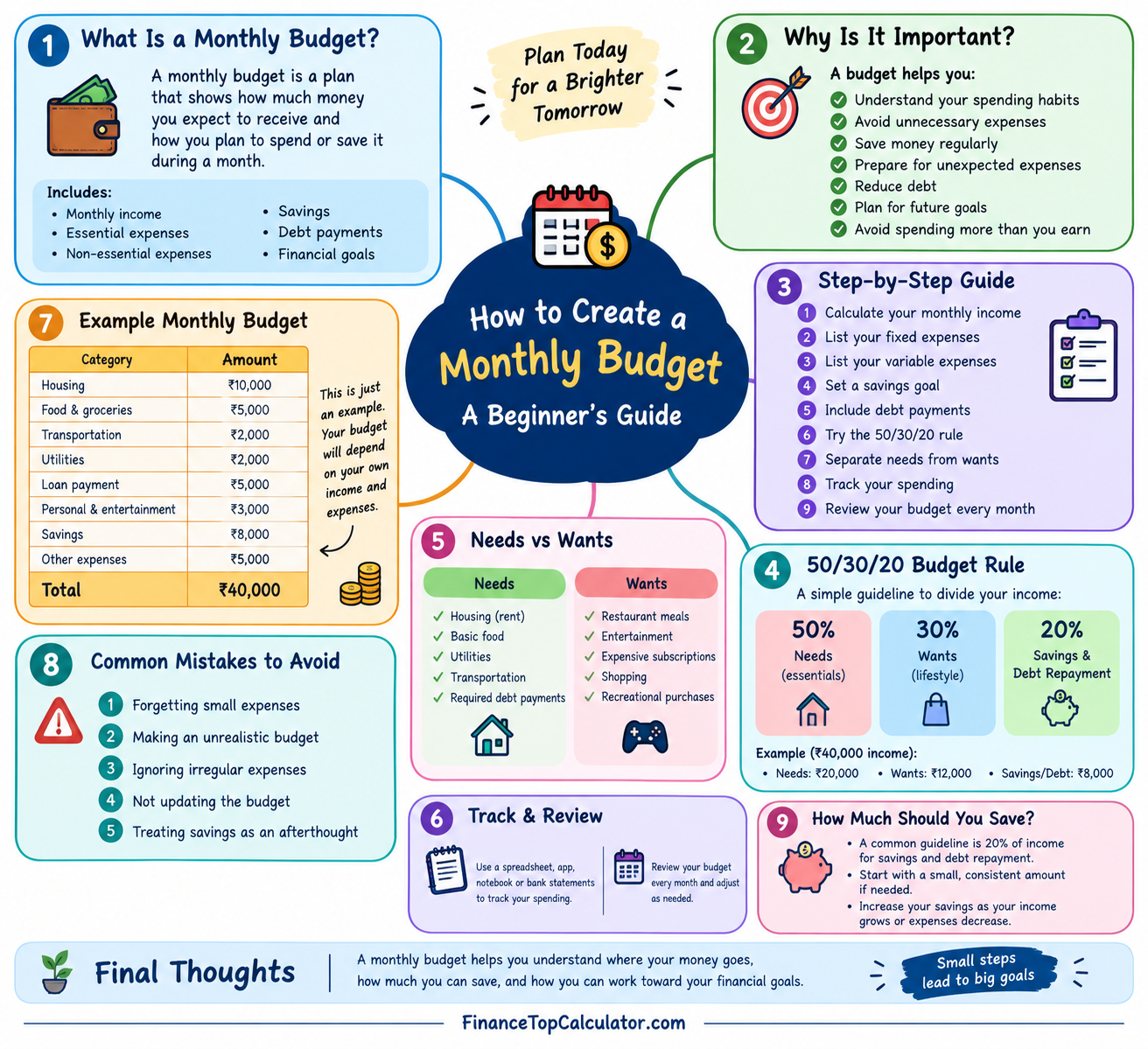
A monthly budget is a simple plan for how you will use your income during a particular month.
It helps you divide your money between different areas, such as:
-
Housing
-
Food and groceries
-
Transportation
-
Bills and utilities
-
Debt payments
-
Savings
-
Entertainment
-
Other personal expenses
The main purpose of a budget is to make sure your spending is planned instead of happening without a clear idea of where your money is going.
Why Should You Create a Monthly Budget?
A monthly budget can help you understand your spending habits and make better financial decisions.
Some benefits include:
-
Better control over your spending
-
More consistent saving
-
Easier debt management
-
Better preparation for unexpected expenses
-
Clearer financial goals
-
Less unnecessary spending
A budget does not mean that you cannot spend money on things you enjoy. Instead, it helps you decide how much you can comfortably spend while still taking care of your important financial priorities.
Step 1: Calculate Your Monthly Income
The first step is to determine how much money you have available each month.
Your income may come from:
-
Salary
-
Freelance work
-
Business income
-
Part-time work
-
Other regular sources
If your income is fixed, calculating it is relatively simple.
For example, suppose your monthly take-home income is ₹40,000.
You can use ₹40,000 as the starting point for your monthly budget.
If your income changes from month to month, consider using a conservative estimate rather than assuming your highest possible income.
Step 2: List Your Fixed Expenses
Next, write down your fixed monthly expenses.
Fixed expenses are costs that usually remain similar from month to month.
Examples include:
-
Rent
-
Loan payments
-
Insurance
-
Internet
-
School or tuition fees
-
Subscription services
For example:
| Expense | Monthly Amount |
|---|---|
| Rent | ₹10,000 |
| Loan payment | ₹5,000 |
| Internet | ₹800 |
| Insurance | ₹1,200 |
| Total | ₹17,000 |
Knowing your fixed expenses gives you a clearer picture of how much money remains for other categories.
Step 3: Estimate Your Variable Expenses
Variable expenses can change each month.
Common examples include:
-
Groceries
-
Electricity
-
Transportation
-
Eating out
-
Shopping
-
Entertainment
-
Personal expenses
Look at your previous spending if possible. Bank statements, payment records, or a simple notebook can help you estimate realistic amounts.
For example:
| Expense | Monthly Estimate |
|---|---|
| Groceries | ₹5,000 |
| Transportation | ₹2,000 |
| Electricity | ₹1,500 |
| Entertainment | ₹1,500 |
| Total | ₹10,000 |
Do not worry if your first estimate is not perfect. You can adjust it after tracking your actual spending.
Step 4: Decide How Much You Want to Save
Saving should be part of your monthly financial plan.
You might save money for:
-
An emergency fund
-
Education
-
A future purchase
-
Travel
-
A home
-
Retirement
-
Other financial goals
For example, if you earn ₹40,000 per month, you might initially set a goal of saving ₹5,000.
The appropriate amount depends on your income, expenses, debt, and financial goals. There is no single savings percentage that works for everyone.
Step 5: Include Debt Payments
If you have debt, include the required payments in your monthly budget.
Examples include:
-
Personal loans
-
Home loans
-
Education loans
-
Vehicle loans
-
Credit card balances
Make sure required payments are accounted for before allocating money to discretionary spending.
If you have extra money available, you can consider making additional debt payments when appropriate, while checking the terms and any applicable charges.
Step 6: Understand the 50/30/20 Budget Rule
The 50/30/20 rule is a popular budgeting framework.
It divides after-tax income into three broad categories:
-
50% for needs
-
30% for wants
-
20% for savings and debt repayment
For a monthly income of ₹40,000, a simplified example would be:
-
Needs: ₹20,000
-
Wants: ₹12,000
-
Savings and debt repayment: ₹8,000
This is a guideline rather than a strict financial rule. Your actual percentages may be different depending on your housing costs, income, family responsibilities, debt, and financial goals.
Step 7: Separate Needs From Wants
One of the easiest ways to improve your budget is to separate essential expenses from discretionary spending.
Needs
Needs are expenses that are generally necessary for your basic lifestyle and financial obligations.
Examples:
-
Housing
-
Basic food
-
Utilities
-
Transportation
-
Required debt payments
Wants
Wants are expenses that are not usually essential but can make life more enjoyable.
Examples:
-
Restaurant meals
-
Entertainment
-
Some subscriptions
-
Shopping
-
Recreational activities
The goal is not to eliminate wants. Instead, give yourself a reasonable spending limit so that discretionary purchases do not interfere with important financial goals.
Step 8: Track Your Spending
Creating a budget is only half the process. You also need to track what you actually spend.
You can use:
-
A spreadsheet
-
A budgeting app
-
A notebook
-
Bank statements
For example, if your monthly entertainment budget is ₹2,000 but you have already spent ₹1,800 halfway through the month, you know that you need to be more careful with the remaining amount.
Regular tracking helps you identify spending patterns and make adjustments.
Step 9: Create a Simple Monthly Budget
Here is an example of a ₹40,000 monthly budget:
| Category | Amount |
|---|---|
| Housing | ₹10,000 |
| Groceries | ₹5,000 |
| Transportation | ₹2,000 |
| Utilities | ₹2,000 |
| Loan payment | ₹5,000 |
| Personal & entertainment | ₹3,000 |
| Savings | ₹8,000 |
| Other expenses | ₹5,000 |
| Total | ₹40,000 |
This is only an example. Your own budget should be based on your actual income and expenses.
Step 10: Review Your Budget Every Month
Your budget should not remain exactly the same forever.
Your income or expenses may change. You might move to a new home, take a new loan, change jobs, or start saving for a new goal.
At the end of each month, ask yourself:
-
Did I stay within my planned spending?
-
Which category cost more than expected?
-
Did I reach my savings target?
-
Were there unnecessary expenses?
-
What should I change next month?
A monthly review can help you gradually improve your budgeting system.
Common Monthly Budgeting Mistakes
Ignoring Small Expenses
Small purchases can add up over time. Tracking them can help you understand your real spending.
Setting Unrealistic Limits
A budget that is too strict may be difficult to maintain. Use realistic spending limits based on your actual lifestyle.
Forgetting Irregular Expenses
Some expenses occur only occasionally, such as annual insurance payments, repairs, gifts, or travel.
Consider planning for these expenses in advance.
Not Tracking Actual Spending
A budget is only useful when you compare your plan with your real spending.
Treating Savings as Whatever Is Left Over
If saving is one of your goals, include it in your monthly plan rather than waiting to see what remains at the end of the month.
How Much Money Should You Save Each Month?
There is no universal savings amount that applies to everyone.
Some people may be able to save a large percentage of their income, while others may have higher essential expenses or debt payments.
The important thing is to create a realistic savings habit and increase your savings when your financial situation allows.
You can also set separate goals for short-term and long-term savings.
Final Thoughts
Creating a monthly budget does not have to be complicated.
Start by calculating your income, listing your fixed and variable expenses, setting a savings goal, and tracking your actual spending. Review your results at the end of each month and make adjustments when necessary.
The goal of budgeting is not to stop you from enjoying your money. It is to help you use your money intentionally and work toward your financial goals.
Start with a simple budget today, track your progress, and improve it one month at a time.
Frequently Asked Questions
What is the easiest way to create a monthly budget?
Start by writing down your monthly income and all your major expenses. Then set spending limits for different categories and include a savings goal.
Is the 50/30/20 rule suitable for everyone?
No. The 50/30/20 rule is a general budgeting framework. Your ideal allocation may be different depending on your income, expenses, debt, and financial goals.
Should savings be included in a monthly budget?
Yes. If saving is one of your financial goals, include it as part of your monthly plan.
How often should I review my budget?
A monthly review is a practical approach. You can also track your spending weekly to identify problems earlier.
Can a budget help reduce unnecessary spending?
Yes. Tracking your expenses can make it easier to identify spending that may not be necessary and redirect some of that money toward savings or other financial goals.